Institutional edition · v2026.4 · 87 pages
Global Policy Convergence Monitor 2026
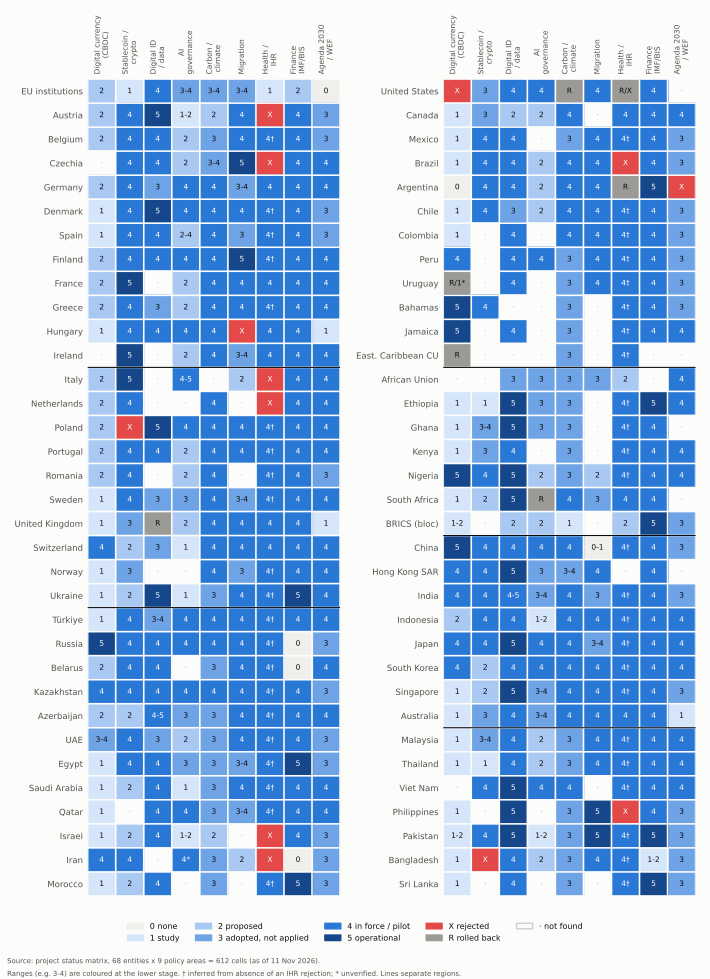
Status of the "Great Reset" agenda by country and policy area, built from published primary documents: laws, regulations, treaties and central-bank, EU, UN, IMF, BIS and WHO texts.
Contents
- Executive summary
- Origins and the narrative test
- Digital currency and stablecoins
- Digital ID and data
- AI governance
- Carbon, climate and finance
- Migration
- Health governance
- Country status: all 68 entities
- What happens next and what is missing
- Implications for investors
- Annex A: method and evidence
- Annex B: milestone charts by country and organisation
Also available
- Evidence Volume (268 pages): the chapter-by-chapter evidence behind every finding, with its limits.
- Country modules for Türkiye, Egypt, Saudi Arabia, Kazakhstan, Azerbaijan, Brazil and Argentina.
- Data pack (Excel): 612-cell status matrix, 716 milestones, 1,138-source register.
- Quarterly updates from Q1 2027: revised numbers and a change log.
Coverage at a glance
How the evidence was built
Each of the 68 entities (64 countries and territories and four blocs) was checked in nine policy areas, giving 612 cells. Each finding is recorded as a claim with its sources and an evidence grade: P primary text read, S secondary sources only, U unverified.
Two independent review passes compared claims with the cited source. Of 553 claims, 154 were independently reviewed on their current wording; 89 of them (58%) needed correction, and all corrections are applied. The limits are stated plainly in the report: 59 cells are not found, 169 rest on secondary sources, and many long documents were read in part.
The research was done with AI assistance under human direction. AI agents searched, read and extracted documents in several languages and ran the review passes; a human editor set the scope and rules and decided open points. Read the methodology and independence statement (PDF).